Home Blog Page 3

Create Your Bar – Classy Home Bar Ideas

Creating a bar in your home is simple if you consider the functionality of the space and the users before deciding how to design your own.

Create Your Bar

You don’t need to be an avid drinker or entertainer to create bar space in your home. It’s a great idea to free up kitchen space and create additional storage and counter space – and who couldn’t use a little more of both in their home?

Location

Bear in mind that the kitchen is the home’s heart. With open concept homes, this is becoming even more so with the kitchen being the hub of the social and entertaining are of the house. When choosing the location of your home bar, keep in mind traffic patterns, particularly in the kitchen and from the kitchen to adjoining rooms. You may not want the bar located far from the kitchen as you will need access to ice, water, mix like juice and pop, and condiments like lemons, limes, Worcestershire, and other spices.

Some of these needs could be alleviated by a well-stocked bar fridge, but inevitably, that little-used item that you forget to stock in both the kitchen and bar leaves you running back and forth.


Additionally, considering that you will have dishes that need to be washed and spills that need to be wiped, a wet bar area is an excellent preparation and clean-up feature. However, if you have a larger party, you will still want to utilize your dishwasher instead of doing all those glasses by hand.

However, you also don’t want the bar located too close to the kitchen as the bar frequently becomes a social center that guests don’t move too far from when chatting, and you don’t want this to impede the chef’s workspaces.

Work Surface

Providing a dedicated work surface or counter for the bar area frees up counter space in the kitchen or prevents a dining table or side table from taking over for the task. In addition, it allows hosts to work simultaneously to serve guests in separate entertainment areas or allow visitors to assist themselves without impeding other food or drink services or preparation.

Cooling Capacity

You will want to consider your drink preferences and guests and what necessities are required in a bar to determine your storage requirements. Many drinks are served chilled so a bar fridge can come in handy and keeps beer, pop, ice out of the way in the large fridge in the kitchen. If these drinks are the preferred beverages, you may also wish to consider a full-sized fridge with a dedicated freezer for the bar area.

Avid wine drinkers may wish to consider a wine rack or wine fridge. Wine coolers can be set at specific temperatures for optimal white and red wine consumption.

Storage Space

Like in bars and restaurants, you will want your glasses handy for serving. Mirrors in all shapes and sizes make beautiful and functional display items that call attention to your bar area and can be appropriate for viewing in open shelving, china cabinets, or custom glass or mirrored display. In addition, doors may help prevent dust from settling on those less used items.

There will be fewer display-worthy items you wish to locate in or near your bar that you might want to hide from view. Like your kitchen, base cabinets or sideboards make ideal hidden storage areas for these items.

Making a Home Bar is simple and doesn’t need to take a lot of space or can be an entire room. Take into consideration the functionality of the area and the primary uses before deciding how to design yours.

The Basics of Kitchen Layouts and Designs

Kitchen Floorplans Come in Four Main Varieties

It is essential when you’re planning out a kitchen. Your house and your requirements dictate which layouts and styles work best. So before you start, learn the basics about kitchen layouts.

When planning a kitchen, the most important thing is to figure out how it will look. Sometimes the layout options will be limited to the size and shape of the room, while in some homes, there will be more options.

While there are many variations within each layout, there are four basic kitchen layouts.

Single-Wall Kitchen Design

The single or one-wall kitchen design is the most basic and is commonly found in small spaces. This kitchen design style is excellent for tiny holes because all appliances, counters, and cabinets are placed against one wall. However, while this style is practical for small areas, its major fault is that it doesn’t use the classic kitchen triangle (helpful in regulating traffic flow and making life easier for the cook).


Galley Kitchens

A galley is a simple design that looks like a corridor. Galley kitchens consist of two opposing counters at least 42″ apart. They need to be at least that distance so that cabinet and appliance doors can be opened comfortably.

Galley kitchens are trendy because they make great use of space. Highly functional galley kitchens use the kitchen triangle while not taking up a large amount of space. The problem with galley kitchens is that they’re not great for traffic flow. Also, accommodating more than one individual might be problematic (depending on the size).

L-Shaped Kitchens

L-shaped kitchens have the same benefits as the galley kitchen but don’t suffer the same overcrowding issues. In addition, with an L-shape, it’s easy to keep traffic out of the work triangle.

L-shaped kitchens are great because the opposite corner of the L can be used for a table and chairs or kitchen island.

U-Shaped Kitchen Designs

The U-shaped kitchen plan is the most adaptable and efficient. It makes the most of the classic work triangle and allows for ease of movement. In this layout, all appliances, cabinets, and food preparation areas face each other and are directed towards a central point. In addition, there is often an island in larger kitchens in the center of the room, allowing for extra workspace and storage.

Kitchen layouts aren’t limited to these designs, but most kitchens are some variation of one of them. What to do or which kitchen design is ideal for your home? Try using an online kitchen planner to experiment with different layouts. Then once you’ve decided on a kitchen layout, you can get to work on renovating and decorating your kitchen.

Save Time and Money with Online Kitchen Planners

Design Your Kitchen Without Leaving the House

Before hiring a designer or contractor, consider using an online kitchen planner. They’re easy to use, practical, and, best of all, free.

Designing a kitchen is a big job. Many considerations have to be considered when planning or renovating a kitchen. The room needs to be functional, practical, and preferably stylish.

Interior designers, contractors, and kitchen design specialists know the ins and outs of good kitchen design. They can help design a kitchen that will suit your needs, but if you want to create a kitchen without the help of one of these specialists, it’s possible with online kitchen planners.


Why Use Online Kitchen Planners

Online kitchen planners can save headaches because they allow homeowners to see a blueprint/model of the kitchen before it’s installed.

Online kitchen planners allow one to view the architectural layout of the room in several different dimensions to get a sense of the space. Adjustments can easily be made for size, the position of items and materials, color, and design.

Popular Online Kitchen Planners

There are hundreds of kitchen planners online that can be found with a simple search.

  • The Ikea Planner allows budding designers to drag and drop furniture and appliances into the room to fit the exact measurements. Move things around and experiment with designs until satisfied, view it in 3-D to be sure, and then print out the plans. It can then be saved onto an Ikea server and picked up at a local store, along with a list of all the products and costs.
  • The Merillat 3D Kitchen Design Planner has several options that range from those suitable for total novices to design experts. Start from scratch, use a template, or try some combination of the two.
  • When it comes to house décor, My Deco is an online resource that can help you with almost any question. They have a 3-D planner that allows you to design a room from scratch. It is great if your room is an unusual size or has a non-traditional layout. It also allows you to add details that other planners don’t.

One can experiment with layouts and designs without committing to online kitchen planners. The planners can be saved to go back and change things if you find a new appliance that you prefer over one you had initially planned and want to change flooring or countertops. Or even make a more significant change like deciding on a different layout.

Online kitchen planners allow for the freedom of change without paying for the time of a designer or contractor. Then once you’ve finally decided and found a plan you’re happy with, you can work on making your dream kitchen a reality.

Painting a Kitchen the Right Color

Kitchen Color Trends

The kitchen is perhaps the most utilized space, but the kitchen design can often lack. Consider these popular color trends for your next kitchen remodel.

Choosing colors for home decorating can be difficult for any room, especially in kitchens. Many people have trouble combining colors with cabinetry. For some fresh, new ideas for kitchen remodeling, check out some of the more popular color combinations for kitchen decorating.

Popular Color Trends for Kitchens

According to HGTV.com, there are some current color trends that interior designers have been using in kitchens. For example, consider these hot color combos for remodeling a kitchen:

Gray and Brown

Brown has always been a popular neutral shade used in kitchens as the central theme – Especially in kitchen cabinetry. However, gray is becoming the new “it” shade for kitchens. Consider pairing the two-gray tile backsplash with brown cabinetry. It makes the kitchen look more modern by giving it a modern twist.


Green and Silver

Because of the move towards eco-friendly design, green has become very popular, even for kitchens. Consider pairing soft green cabinetry or a green tile backsplash with silver, stainless steel appliances. Silver cabinet hardware adds a contemporary touch. The green and silver combination creates an overall modern look, country chic.

Red and White

A crimson kitchen is an option for the more daring. You can make your kitchen look classy and elegant by having red walls or a red backsplash. Instead, choose red cabinetry and dark gray walls with stainless steel accents to add a little sparkle to the room for a more bold look.

Blue and Black

Blue has always been a soothing, relaxing shade, so it has traditionally been used in bedrooms. But now, designers are bringing blues out into the kitchen as well. Try pairing painted blue cabinets with jet-black countertops. Add silver accents by updating the hardware to stainless steel. The result will be truly spectacular.

Jewel Tones

Jewel tones, emerald green, and ruby red will pop in a kitchen when paired with dark cabinetry. Combine a jewel-toned glass backsplash with dark gray cabinets for a modern and sophisticated kitchen design. A clean, stylish appearance with silver cabinet hardware and stainless steel appliances finish the look off with a very simple and subtle countertop in a neutral white or white sparkle.

Black and White

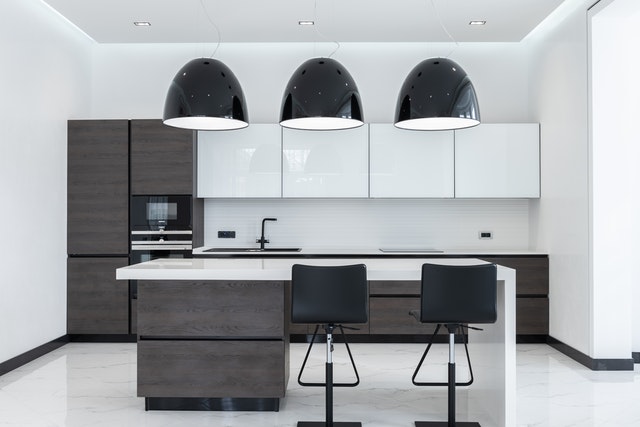
Black and white always has and always will be a popular and sophisticated color palette for any room. It won’t look boring if done right—pair black cabinetry with a crisp, clean white countertop. Highlight the dark cabinetry with silver hardware for a sleek look. Keep the kitchen walls white to keep them light and airy. The color scheme can also work in reverse, with white cabinetry and black countertops. Just keep the silver accents.

With these hot new color trends, you’ll be able to turn any dull kitchen into a fantastic cooking paradise. With the variety of color choices, it’s easy to use one of these color combinations in any home. So here’s to a fabulous new kitchen!

Kitchen Island Stoves

Maximizing the Kitchen’s Working Triangle

Large kitchens and open format kitchens can use a kitchen island cooktop to make the most of the space and the kitchen design.

Kitchen islands are becoming an increasingly popular component of large and open concept kitchen designs. When a kitchen layout becomes so large that the trip between the sink, stove, and refrigerator starts to make cooking and use of the kitchen cumbersome, the kitchen island becomes the ideal spot for the stove.

Laying out the Kitchen Design

When laying out the kitchen design, it’s essential to consider the working space between the most utilized areas of the kitchen. For example, the sink, stove, and refrigerator are the primary working areas of the kitchen and, when laid out properly, should form the design of a triangle known as the working triangle.

To maximize the use of the kitchen design, the working triangle should have a total distance between the three centers of no more than 26′, and each leg of the triangle should be no greater than 9′. However, in huge kitchens and open concept kitchens that open into other homerooms, the working triangle in a conventional design may start to get too large to remain functional. In this case, including a kitchen island in the design and installing the stove or cooktop at this point makes the kitchen more user-friendly.


Venting a Kitchen Island Stove

All cooking surfaces must be correctly vented according to code. While most regulations specify venting each cooktop according to the manufacturer’s specifications, some guidelines are to follow.

A cooking vent should be wider than the cooking surface by 6″; 3″ on either side and the vent must be ducted to the outdoors. There are two styles of vent that are generally available for an island stove, although specifications will vary by manufacturer.

A kitchen island hood is available and is the most effective form of venting from a kitchen island. The hood comes down directly from the ceiling and should be centered over the stove, extending outward on each side and behind the stove by 3″.

If ducting and venting the kitchen island through the ceiling is not available, some stoves and cooktops are available with a vent inside the kitchen island until needed. At this time, the movable duct can rise out of the island extend upward behind the cooktop and vent as required. However, this form of venting should only be used as a last resort, as these types of vents may not provide adequate ventilation for all cooking.

Nearly any form of stove or cooktop is available to be installed on a kitchen island. In some cases, just the cooktop may be installed, with the oven placed inside cabinets nearby. Before making this decision, the homeowner’s cooking habits and kitchen use should be considered.

Consider using a kitchen island stove or cooktop to maximize the working triangle of the kitchen design and get the most use of the kitchen today.

Designing with White Backsplash Tile


White Kitchen Tile Backsplash Ideas

A simple backsplash of white on white or predominately white tile is a popular look in a kitchen design. White kitchen backsplashes of any material can enhance any look.

 Personalize your kitchen backsplash, finish, and add style to the kitchen design. When the kitchen design includes multiple features, sometimes the best backsplash tile design is made with white tile. Solid white, tone-on-tone, or as a background for a secondary accent color, a white kitchen backsplash can enhance any kitchen from classic to modern in style.

Adding Interest with Only White Tile

A white kitchen backsplash with no secondary color does not have to appear dull or drab. Instead, depending on the tiles used and how they are placed, a white kitchen backsplash can have a lot of detail and design.

When designing a white backsplash, consider using some of the following elements to enhance the design.


  • Use handmade tiles to bring textures and movement to the space
  • Use three-dimensional tiles, both decorative and field tiles, to add detail
  • Mix different materials of white tiles together, such as white glass mixed with white stone
  • Change the sizes of tile throughout the space, including one size as a border, one as a field, and a third behind the cooktop
  • Change the pattern of the tile from the counter to the area behind the cooktop, such as running bond mixed with a herringbone

Adding a Secondary Color

Sometimes just a hint of color is desired to break up the amount of white in a kitchen and add some depth to the style. If using an accent color against a white field, try some of the following ideas.

  • Use a repeating pattern of small cut-in tiles laid in the corners of field tiles
  • Create a very subtle shading through the area by mixing cream with the white tiles in a patchwork effect
  • Confine the color to a border that outlines the tiles behind the cooktop
  • Pull the color from another area of the kitchen to ensure a cohesive design

Things to Watch Out For

There are multiple shades of white that can be created by tile glazes, stones, and glass tiles. When mixing white tiles, accent colors, and field tiles from the same company, be sure to look at samples of the tiles in the kitchen at all times of day before purchasing and installing. Some shades of white may appear slightly blue, pink, gray, yellow, or just plain dingy when laid against other shades of white. Be sure that the shades of white being considered in the kitchen work well together and complement one another before installing them.

Using two-sided, heavy tape, tiles can be hung from the backsplash area for a few days, where they can be viewed in the morning, afternoon, and evening light to ensure that they will coordinate. Even if the tile samples need to be purchased, it’s better to know ahead of time than to install a backsplash that brings unwanted color or shading to the room.

White kitchen backsplashes can be used in nearly any kitchen design. For example, use white glass tiles in modern kitchens and white, Thassos tumbled stone in rustic kitchens. Handmade tiles can complement a range of styles, while machine-made tiles with three-dimensional accents work in transitional designs.

Create a white kitchen backsplash in any kitchen design to create a restful place for the eye amid the kitchen design.

Considering Marble Kitchens

Kitchen Design with Marble Countertops

Marble kitchen counters may be appealing for their unique beauty. There are many different types of countertops. However, marble kitchen countertops are the least recommended.

Kitchen countertops are the kitchen design’s workhorse. Their color and decorative style contribute to the kitchen’s overall strategy, but they also take a lot of punishment. When someone sits on a kitchen counter, they are exposed to spills, boiling pots, sharp utensils, and even the back buttons of trousers. Even when a homeowner is careful of their counters, a collapse or a piece of grit dragged across the counter under a plate can leave a mark. Therefore, it’s essential to consider the strength and upkeep, along with its price, beauty, and desirability.

The Characteristics of Marble Counters

Marble is a metamorphic stone comprised mainly of calcite. When limestone undergoes tremendous heat and pressure deep in the earth, it forms a hard, dense rock capable of high polish. The veins and colors of marble are produced by impurities surrounding the limestone at its transformation, and no two slabs of marble are ever the same.

Marble has been utilized as a construction material and artistic material for ages. Capable of being carved, drilled, polished, and cut, marble has been used in sculptures, tiles, counters, and walls in countries worldwide.

While marble is a hard stone, capable of being ground to polish, it is a softer, more porous stone than granite, another frequently used material on counters. Marble is easily cut or marked with sharp knives, stained by grease, and etched by acids like tomato juice or lemons. A marble counter will show the years of use that it receives by mellowing and developing a patina as time goes by.

Marble in Today’s Kitchen

Marble can make a beautiful statement in many kitchens with its beautiful veins and high polish. Popular with kitchen designers in show and spec homes and used in Europe for years, marble is often photographed in show kitchens and displayed in kitchen design ads. It can lead homeowners to consider a marble counter as part of their kitchen design.

Many homeowners may not consider that marble in a kitchen will rarely retain the high polish and unmarred surface it exhibits when first installed. While marble has been used widely in kitchens throughout Europe, there is an understanding of the marble age and patina. The stone is desired not for its polish and beauty but its use when baking and how it helps prepare the dough and other foods.

According to Bernard V.*, a countertop manufacturer, in a recent interview with Suite101, marble is not a recommended kitchen counter for anyone who wishes their kitchen to remain in the same condition in which it was installed. “I would get phone calls, months after installation, asking me to come back and refinish a dull spot or how to get rid of a stain. So I finally stopped selling marble for kitchens. I explain to homeowners that it will stain, no matter how careful they are, and I don’t think they believed me until it was too late.”

Marble counters are an excellent choice for bakers, cooks, and those who understand that over the years, the beauty of the material will lay not in a high gloss finish or subtle veining but the history of the kitchen. Every meal, visitor, and pot and knife will leave behind its impression. So choose a marble counter for its use and past to ensure its continued desirability in the kitchen design.

*Last name withheld at interviewees’ request

Different Kitchen Countertop Ideas and Designs

Countertop Options & Materials to Match any Kitchen Design or Décor

Kitchen countertops add much to a kitchen’s design. Choosing the suitable materials out of the many options available is essential to creating the kitchen that one wants.

Countertops are an essential part of any kitchen’s design and decoration. As one of the kitchen’s most prominent and most visible design components, they set the whole tone for the room. They can make a kitchen look modern, rustic, luxurious, or classic. Once one figure out what type of kitchen they want, choosing the right countertops for that type of room is essential.

Granite Countertops Create an Elegant Kitchen

Granite countertops are trendy. Durable and straightforward to clean. They are also beautiful to look at. They can turn a drab kitchen into an elegant and classy one instantly after installation. They add sparkle to the room and come in many different colors. No matter the kitchen’s color palette, there is a granite countertop to match as they range from black to green to pink and every shade in between.

Ceramic Tile Countertops Create a Classic Kitchen

Ceramic tiles are what most people think of when they think of kitchen countertops. This relatively inexpensive material creates a classic, timeless look in the kitchen. Ceramic tiles have worked well in the kitchen for many reasons. They can withstand hot pots and pans and are easy to clean. The only difficulty with them is the grout between the tiles which may be harder to clean. Other than that, one can’t go wrong with classic ceramic tile countertops.

Designing a Modern Kitchen

Stainless steel countertops are sleek and fashionable. They give the kitchen a clean industrial look. They can withstand heat and are extremely easy to clean up. They are also easy-to-match accessories as most large and small kitchen appliances now come in stainless steel. These modern countertops may not be for everyone, though. Some complain that they are noisy and that they dent easily.

Butcher Block Countertops Create a Rustic Kitchen

Butcher block is a type of countertop that is made of wood. It gives a kitchen a rustic, country feel. It is warm and inviting. So easy to clean, it can endure hot pans. If a butcher block countertop is scratched, it can easily be fixed by a quick sanding and resealing. Unfortunately, over time butcher blocks can be damaged by water and even stained.

Countertops are essential components of design in the kitchen. Choosing the right ones will help homeowners to create the kitchen of their dreams, whether it is an elegant, classic, modern, or rustic look they are going for.

Electrical Outlets In Color

No more looking for colored electrical outlets for your new kitchen design. Instead, you can find them here.

Faceplates and Receptacles

There are two exterior parts to most electrical outlets: the faceplate (also known as the wall plate or outlet cover) and the receptacle—that part of the electrical outlet where you plug in your appliances. Faceplates come in hundreds of hues, textures, and colors. Wonderful! But there are rarely electrical outlet receptacles match the faceplates (more now than in recent years). The standard colors include white, ivory, grey, and black—with no texture. What a combo this creates! It is tough to find textures that will match glass, stone, and other new and unique backsplashes.

Simple Solution

A simple solution can be performed in a couple of hours, depending on whether you are working in a new kitchen or a newly remodeled one. Just a can of spray paint and some materials This solution will save you money and allow you to match your faceplates with creative color and texture.

How To Do It

Purchase white or ivory electrical outlet receptacles (unless you already have them) along with your favorite faceplates. Next, search for faceplates on the internet for excellent results. Next, get some spray paint from a hardware store (preferably a washable and textured one that will cling to the mirror of the electrical outlet receptacle), a roll of painter’s tape, and some sandpaper. It will help sandpaper the surfaces of the electrical outlet receptacles, primarily if you work with semi-gloss or gloss paint.

If you install new electrical outlets, spray the receptacles before installing them. Remove the faceplates if you redesign your kitchen, and your electrical outlets are already in place. In both cases, insert a rolled piece of tape into each receptacle opening, so no paint enters the electrical area. Tape newspaper onto the surrounding wall and countertop areas. Spray each electrical receptacle with care. If overspray is an issue, you may choose to detach the wiring and spray paint them outside or in the garage.

The Result

Once dry, remove the newspaper and tape, attach the faceplates, and inspect your work. The electrical outlet receptacles and matching faceplates will beautifully blend into your new kitchen design. You may need to touch up the plug-in areas every few years, depending on the paint you selected and the usage of each electrical outlet.

Range Cookers: A Buyer’s Guide

Many of us say we want a range cooker, but we don’t have the same product in mind. So what is a range?

There are two genres of range cooker: the traditional heat-storage cast-iron stove that needs a flue and is on all the time so that it, in turn, is always emanating heat into the kitchen. The other is a large heavy-duty freestanding cooker with two or more ovens, five or six burners, and turns on and off.

Heat Storage

Heat-storage ranges, which date back a few hundred years, are made by AGA, Rayburn, Everhot, Esse, Redfyre, and Stanley. Their products run on gas, oil, or wood, and some models have a boiler to provide hot water and central heating.

These products are undoubtedly less in demand than they were, mainly because of the steep rise in fuel prices. Whereas running a gas-fired range might have cost £1 a day a decade ago, costs today may well be around £30 a week.

So who would need one? If you reside in the country, not on the gas grid, an oil-fired or wood-burning range that heats your water and radiators is a god-send. In addition, many products today are far more energy-efficient than they were, such as Rayburn’s Heatranger 680KCD, which features an A-rated condensing boiler.

There are, of course, people who like them traditional ranges because they are homely and keep the kitchen warm, and we appreciate the way food tastes cooked in them.

Tradition Meets Electricity

The rise in fuel costs has forced traditional manufacturers to introduce electric versions of their products, which may be turned off. Redfyre’s Electric Range with Warmfront Technology has become its best-seller, while AGA has likewise has launched its high-tech Total Control model, which can be turned on and off.

Cooking in Quantity

The other range is a big on/off a multi-oven appliance that cooks beautifully and is associated with professional kitchens. French brands Lacanche and La Cornue are popular with well-known chefs, while manufacturers of stylish, high-end appliances include Falcon, Britannia, Steel, Wolf, and Rangemaster. Mid-range manufacturers of excellent ranges include Stoves, Caple, Smeg, and Belling. And as Rupert Cotterell of Lacanche points out, A standalone cooker also has the benefit of portability.

Fuel Type

Choose from gas, electric, or dual fuel. And it’s worth noting that many manufacturers can convert their models to run on LPG. Many fields come with gas hobs, but a lot is available with induction hobs. Perceived wisdom has been that it’s best to have a gas hob and electric ovens. Still, induction hobs are considered more energy-efficient because some 90 percent of the heat goes into the pan, whereas a lot of heat from a gas flame dissipates in the room during cooking time.

And in the days of rising gas and electricity prices, why not consider a wood-burning range? The Esse 990 burns wood or mineral fuel and heats quickly from cold, so it doesn’t have to be on. So don’t dismiss wood-burners as being a bit “Tom and Barbara” from The Good Life, which for non-UK residents was a hilarious BBC series in the 1970s about a middle-class couple trying to live off the land their garden…in suburban Surrey.

Aesthetics

Choose from the 1930s enamel stove look with electrical products from AGA or Redfyre, or perhaps you prefer the modern professional stainless steel look. But I don’t think a range should look dark and industrial to mean business. Lacanche makes heavy cast iron ranges, but they are available in almost any color and look very chic and 21st century in tangerine or lime green. Italian manufacturer Steel has a range clad in panels that can be changed if you tire of your original shade. So throw color caution to the wind and make a design statement.

Sizes

Whatever size your kitchen is, you will find a range to fit. For example, stoves make an endearing mini range cooker just 552mm wide for the studio-flat dweller, while if you live in a chateau, you’ll need the 1800mm Grand Palais range from La Cornue. However, the 900mm and 1000mm widths are most popular, accommodating in many UK kitchens.

So before deciding on what to buy, consider what you want the range for, what fuel best suits your budget and location, and then find the model with the cooking features you need. Then you can be sure it’s a buy that will endure decades.